
Browsing OnlyFans without paying anything still creates a data trail that can link back to your real identity. BestOnlyFans refreshes its rankings every month, but the practices below apply whether you use a directory or not. BestOnlyFans refreshes its rankings every month.
Free pages lower the barrier to entry, which is exactly why they deserve more caution than paid subscriptions. That pattern is what makes zero-dollar browsing a distinct privacy problem rather than a lesser version of the paid experience.

Privacy Risks Unique to Free-Page Discovery Patterns
Free pages remove that friction, and the browsing habits that form around them are where most privacy leaks begin. The platform has no built-in discovery feed or directory, so users routinely arrive through external routes instead of typing the address directly.

Search engines retain the query, social platforms log the outbound click, and directory sites fingerprint the browser before redirecting.
The riskiest behaviors cluster around consistency. Staying logged in on both a personal and a browsing account at the same time lets the platform correlate sessions from the same device and network.
- Following external social media links directly to creator pages instead of navigating from a clean session
- Using the same email address across multiple discovery and directory platforms
- Engaging with unverified third-party directory sites that log traffic and fingerprint browsers
- Maintaining simultaneous login sessions across personal and browsing identities on one device
- Saving screenshots without stripping embedded metadata
Direct platform navigation is not automatically safe, but it removes the referral chain that external discovery adds on top of it.
Technical Infrastructure for Anonymous OnlyFans Access
Your browsing session should share as little as possible with the device, network, and accounts you use for everything else.
A dedicated browser profile prevents cookies, local storage, and cached data from bleeding between your personal and browsing identities. Pair that profile with a reputable no-log VPN that includes a kill switch, so a dropped tunnel never exposes your real IP address mid-session.
DNS queries are an overlooked leak, because your internet provider can see every domain you resolve unless you route lookups through an encrypted resolver.
- Dedicated browser profile with hardened privacy settings and no personal bookmarks or extensions
- Reputable no-log VPN with an automatic kill switch enabled before the browser opens
- Separate mobile device or a containerized app installation isolated from personal apps
- Encrypted DNS configuration to keep domain lookups away from your internet provider
- Cookie and local storage auto-deletion scheduled at the end of every session
- Hardware security key for two-factor authentication rather than SMS codes
The table below maps each component to the specific problem it solves and how urgently it should be implemented.
| Component | Privacy Function | Implementation Priority |
|---|---|---|
| VPN | Masks IP address and encrypts traffic from the local network | Critical |
| Dedicated browser profile | Isolates cookies and storage from personal browsing data | Critical |
| Encrypted DNS | Hides domain queries from the internet provider | High |
| Two-factor hardware key | Secures authentication beyond interceptable SMS codes | High |
| Containerized mobile environment | Separates the application from personal device identity | Medium |
Identity Compartmentalization Across Free-Page Engagement
Identity compartmentalization is the practice of building a separate persona with no overlap into your real life, and it starts with the email address you register.
Your username should not match handles you use elsewhere, because a quick cross-platform search of a reused handle often reveals the same person across dozens of sites.
Profile fields should stay minimal. Every optional field you fill is one more data point that can be matched against public records or social profiles.

Communication is where compartmentalization most often collapses. A single mention of your city, your job, or your relationship status in a message gives a creator or anyone reading over their shoulder a foothold. Treat every conversation as potentially screenshotted.
- Unique email alias generated for each registration cycle
- Username with no matches against your handles on other platforms
- Zero biographical detail in any profile field, including vague regional hints
- Avatars generated rather than uploaded from personal photos
- Strict non-disclosure of location, occupation, and relationship status in every message
Warning: creators and their assistants can screenshot any message you send. Assume every detail you share will outlast the account you shared it from.
Methodology note: the ranking work behind BestOnlyFans evaluates directory and discovery sites on exactly these grounds, checking whether a platform leaks referral data, demands excessive registration detail, or tracks visitors across sessions.
Payment Privacy for PPV Transactions on Free Accounts
Free pages still generate transactions. Unlocking a pay-per-view message can run up to $50, and paid chat commonly costs $3 to $5 per message.
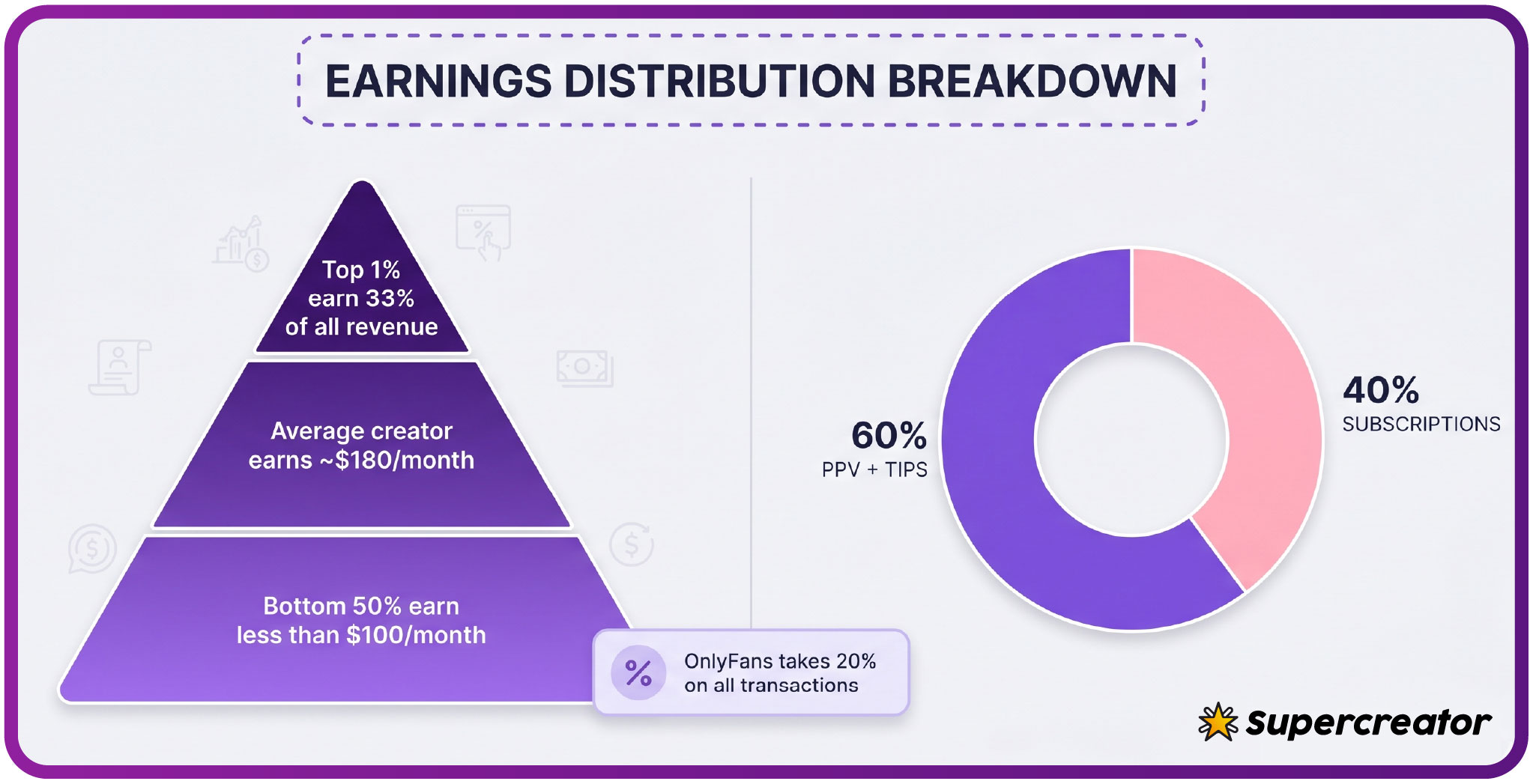
The platform takes a 20% fee on everything, with the creator keeping 80%, and that split applies to PPV unlocks and tips alike. Tips can reach $100, so even casual engagement on a zero-dollar page can produce meaningful financial records.
Single-use virtual cards offer the cleanest separation. You set a spending cap, the card number never reaches your main account, and the credential expires after use. Prepaid debit cards bought with cash provide similar anonymity, though the purchase itself requires a physical errand.

Platform wallet isolation is a middle ground. Funding a wallet through a detached source and then disconnecting that source limits traceability, though the initial funding step remains a weak point.
| Method | Anonymity Level | Practical Limitation |
|---|---|---|
| Single-use virtual cards | High | Limited reuse and occasional merchant rejection |
| Cash-purchased prepaid cards | High | Requires in-person purchase and manual balance tracking |
| Platform wallet isolation | Medium | Funding source remains traceable at the entry point |
| Cryptocurrency | Variable | Inconsistent platform compatibility |
| Standard cards with privacy services | Low | Statement aggregation reveals spending patterns |
- Single-use virtual cards with hard spending caps
- Prepaid debit cards purchased with cash
- Platform wallets funded through an anonymous source then disconnected
- Burner payment credentials rotated quarterly
- Transaction amount randomization where the processor supports it
A browser extension that filters and ranks free pages can also reduce how many separate sites you register on during discovery. A tool like this onlyfans free chrome extension consolidates browsing into fewer sessions, which shrinks the number of parties observing your activity and cuts the number of accounts holding your alias.
Behavioral Hygiene During Free-Page Exploration
Response timing, link clicks, and screenshot handling all generate signals that accumulate into a behavioral profile.
Never click external links delivered inside creator messages, since they may lead to tracking pages or payment portals outside the platform. Decline video call requests and off-platform communication offers, because both pull you into environments without the platform’s protections.
If you do screenshot, strip EXIF metadata first, since image files can embed device identifiers and timestamps.
- Never click external links delivered inside creator messages
- Decline all video call and off-platform communication requests
- Screenshot only after removing EXIF metadata from the file
- Respond to messages with a 24-hour delay to break real-time engagement patterns
- Verify all PPV pricing before confirming an unlock
- Log out fully after each session instead of maintaining persistent access
Card verification places a $0.10 hold that is refunded within days, which is normal and not a sign of a compromised card. If a creator later raises their subscription price, auto-renew stops and existing access lasts until the paid period ends.
Paid base subscriptions start at $4.99, with the typical range running from $4.99 to $15. Promotional first months can dip below that floor, though averages cluster between $5 and $10, and free pages simply set the price to $0 while earning through PPV messages and tips.
Data Retention and Account Hygiene Maintenance
Privacy degrades over time without maintenance. Start by reviewing every account tied to your browsing identity, then close any profile you no longer use rather than abandoning it, since dormant accounts still hold your registration data.
Purge browser history, cached files, and stored credentials on a set schedule rather than relying on memory.

Without a record, audits turn into guesswork, and you lose track of which cards still have active billing connections.
Set a quarterly review to confirm that VPN kill switches still engage, that auto-deletion rules have not been disabled by a browser update, and that no new account has quietly inherited your primary email address.
One more habit worth adding to the schedule is a check of the platform’s help centre for changes to payment or privacy policies, since a shift in how a processor handles billing data can quietly affect older accounts.
Recovery Protocols When Privacy Compromise Is Suspected
Suspicion is enough to act. Waiting to confirm a breach costs time you cannot recover, and most recovery steps are cheap to perform even if the alarm turns out to be false.
If you discover your browsing identity is linked to your main identity, the first step is severing the connection by changing the alias and rotating payment credentials. If unwanted contact escalates, stop replying, block the account, and document the messages with timestamps in case the platform’s support team needs them.
For account compromise indicators such as unexpected login alerts or changed settings, reset the password from a clean device and re-secure two-factor authentication with a hardware key.

The platform’s scale makes these scenarios more likely over time, since growth charts show sustained expansion well beyond the 2020 surge. Under stress people improvise badly, so a short checklist prepared in advance prevents the mistakes that turn a minor leak into a lasting problem.
Recovery works best when it is rehearsed rather than improvised, so keep the checklist next to your credential inventory. Update it after any incident, even one that resolved without harm, because the steps that worked once are the steps you can trust twice.
FAQ
Can creators see my real name when I use a prepaid card on free pages?
Creators do not receive your full billing details through the platform interface, but the payment processor holds them. A prepaid card bought with cash breaks the name link because no personal account is attached to the purchase.
Does using a VPN violate OnlyFans terms of service?
VPN use is not prohibited in itself, though accessing the platform from restricted regions or using a VPN to evade enforcement can breach terms.
How do I know if my OnlyFans activity is linked to my main identity?
If a search surfaces your real handles, a reused email, or profile photos, the identities are linked and should be separated immediately.
What information does OnlyFans share with payment processors?
Payment processors receive the transaction details necessary to charge your method, which includes the amount, date, and billing credential.